Epic Games has been quietly building toward this for years. On May 24, 2026, during the Rocket League Championship Series Paris Major, of all places, the company made it official: Unreal Engine 6 is real, it’s in development, and it already has its first confirmed partner game.
For game developers, technical directors, and studio leads, this is the kind of announcement that quietly reshapes planning, as the decisions you make on engine investment over the next two years will look very different depending on where Unreal Engine 6 lands.
This article breaks down what is actually confirmed about UE6, what is informed speculation, how it stacks up against UE5, and what it means for studios building games right now.
What is Unreal Engine 6 and when does it arrive?
Unreal Engine 6 is the next major version of Epic Games’ engine – the planned successor to UE5, which launched in April 2022. At its core, UE6 is designed to unify the traditional Unreal Engine codebase with the Fortnite tech stack, merging what have historically been two separate ecosystems into one cohesive platform.
The May 2026 reveal at RLCS Paris was the first time Epic confirmed it using an actual partner game, Rocket League, showing a visually upgraded build running on the new technology stack.
Unreal Engine 6 | Official Rocket League Teaser
Which games will use Unreal Engine 6?
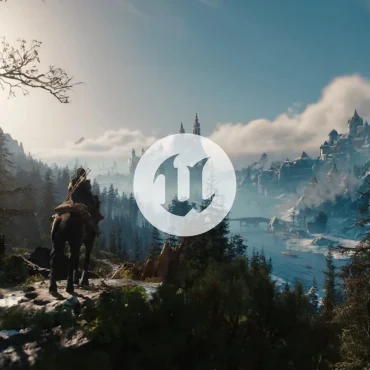
Rocket League is the only officially confirmed UE6 title so far. CD Projekt Red’s The Witcher IV has been cited as a speculative candidate given how far off its release still is and how it switched to UE. But nothing has been confirmed yet. At N-iX Games, we also think that LEGO Fortnite and other Fortnite ecosystem projects are likely early integration targets given Epic’s stated cross-platform goals, but again – those are informed inferences and our thoughts, not officially announced titles.
How does this timeline compare to past releases?
UE versions have historically taken 4 to 5 years between major releases, with UE4 to UE5 stretching seven years. Epic confirmed UE5 in 2020 and shipped it in 2022; by that pattern, UE6 can be live in 2028-2030.
There is no urgency to wait for UE6. Staying on UE5 now and evaluating UE6 when its preview build drops is the rational approach for any studio in active production.
Unreal Engine 6 key features
Epic has not published a full feature list for UE6. Here’s what we have found so far.
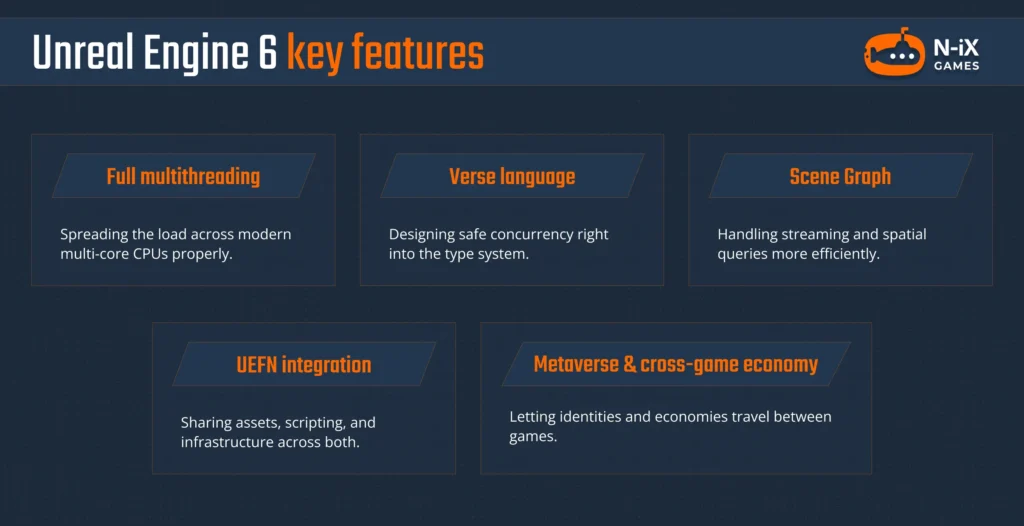
1. Full multithreading
UE6 is targeting multi-threading as an explicit upgrade area over UE5, and engineers will likely cheer loudest for this one. UE5 improved task distribution over its releases, but high-actor-count open worlds and heavy simulations still hit architectural walls.
True engine-level multithreading would spread that load across modern multi-core CPUs properly, smoothing out the frame-time spikes that currently eat hours of optimization work.
2. Verse language
Verse is Epic’s purpose-built scripting language, currently available inside Unreal Editor for Fortnite (UEFN), and the expectation is that it becomes a first-class citizen in UE6 alongside Blueprints and C++.
Verse builds safe concurrency into its type system from the ground up – unlike C++, where threading bugs are easy to write and painful to find. A production-grade integration would let teams hand more gameplay logic to designers safely.
Note: this isn’t officially confirmed by Epic yet.
3. Scene Graph
UE5’s answer to large open-world streaming was World Partition – a grid-based, data-layer-driven system replacing old-style level streaming. UE6 is expected to build on this with an overhauled Scene Graph handling dynamic object relationships, spatial queries, and streaming decisions more efficiently.
The payoff of Scene Graph:
- Faster load times;
- Better memory management in worlds packed with thousands of actors;
- Finer streaming control for level designers without custom C++.
4. UEFN integration
Epic has repeatedly discussed building a connected platform where assets, worlds, and gameplay systems move fluidly between projects, and UEFN integration is where that vision gets concrete. Today, UEFN and standard Unreal Engine are sibling products with real technical divergence.
UE6 aims to close that gap, so content built in Unreal Editor for Fortnite could work inside UE6 projects and vice versa, sharing asset formats, Verse scripting, and publishing infrastructure across both.
5. Metaverse and cross-game economy
This is the most speculative piece, and the one generating the most headlines. Epic’s metaverse vision centers on assets, characters, and economies traveling between games – persistent identities, cosmetics that follow you across UE6 titles, a creator economy not locked to one game.
Tim Sweeney has made interoperability central to Epic’s long-term strategy, but scaling Fortnite’s version of this to third-party studios is a very different challenge.
Beyond these five areas, Unreal Engine 6 is also expected to bring forth:
- Real-time AI voice acting for prototyping and localization;
- AI-assisted content creation in the editor;
- Cloud-gaming optimized asset pipelines.
Unreal Engine 5 vs Unreal Engine 6: Key differences
UE5 data reflects a mature, production-ready engine. UE6 data reflects confirmed intentions, public signals, and reasonable inference, not shipped features, at least not yet.
Unreal Engine 5 vs Unreal Engine 6 feature comparison
| Feature / Area | Unreal Engine 5 | Unreal Engine 6 | Status |
|---|---|---|---|
| Release status | Available; 5.x stable | Teased May 2026; no release date | Confirmed |
| First public game | Multiple AAA titles since 2022 | Rocket League (teaser only) | Confirmed |
| Multithreading | Improved in 5.x; CPU bottlenecks remain | Targeted as explicit improvement area | Estimated |
| Scripting | Blueprints + C++; Verse in UEFN only | Verse integration in core engine (likely) | Estimated |
| Rendering (Nanite) | Virtualized geometry; static meshes | Nanite v2 for animated meshes and foliage | Estimated |
| Global illumination (Lumen) | Real-time GI; performance trade-offs on low-end | Lumen 2.0 – improved accuracy, lower cost | Estimated |
| Open-world streaming | World Partition system | Enhanced Scene Graph with dynamic streaming | Estimated |
| UEFN integration | Separate product, technical divergence | Planned convergence with UE6 | Estimated |
| AI authoring tools | Limited native AI tooling | AI-assisted content creation in editor | Estimated |
| Cross-game economy | Not present | Metaverse / cross-game asset portability | Speculative |
A note on Nanite and Lumen
UE5’s Nanite was a real step change for environment art, but it never supported skeletal or animated meshes. Nanite v2 is expected to extend that to characters and dynamic geometry.
Lumen’s lighting is accurate but costly in real time, often forcing hardware concessions or baked-lighting fallbacks. Lumen 2.0 aims to cut that cost without losing quality, which would shift platform support decisions for multiplatform releases.
What this means for game developers
The honest answer for a team in active production right now: not much, yet. UE5 is the place to build; UE6 has no preview build, and no migration tooling right now. So, skipping UE5 to wait for UE6 means wasting the next 18–24 months of productive development time on an engine that doesn’t exist in any shippable form.
That said, this announcement matters for planning. Here’s how different team types should read it:
- Studios in early pre-production (2026–2027 starts):
Stay on UE5. Invest in Nanite, Lumen, and World Partition workflows now. These will transfer cleanly to UE6 because Epic is extending these systems. Teams already proficient in UE5’s rendering pipeline will have a shorter ramp when UE6 tooling matures. - Teams building live-service or multiplayer games:
Pay close attention to the UEFN integration track and the Fortnite-sourced multiplayer infrastructure. Epic has been stress-testing live-service infrastructure on Fortnite for years: netcode, matchmaking, anti-cheat, live deployment pipelines. All of that experience flows into UE6 as default tooling, which means mid-size studios could get production-grade multiplayer infrastructure without building or licensing it separately. - Those exploring metaverse or cross-platform economies:
The cross-game vision is still largely speculative, but it’s the direction Epic is clearly heading. If your roadmap includes persistent player economies or cross-title asset portability, this is the engine ecosystem to watch. - Teams evaluating C++ vs Blueprint depth:
If Verse does land in UE6 as a first-class scripting option, it changes the balance between prototyping speed and production stability. Worth factoring into how you’re structuring your scripting conventions in UE5 today.
What does it mean for us? At N-iX Games, we have spent the past decade building deep UE expertise across a range of projects: from large-scale open worlds to technically complex multiplayer titles. For example, the series of story-driven horror games The Dark Pictures Anthology, a puzzle-adventure game Little Nightmares III, and others.
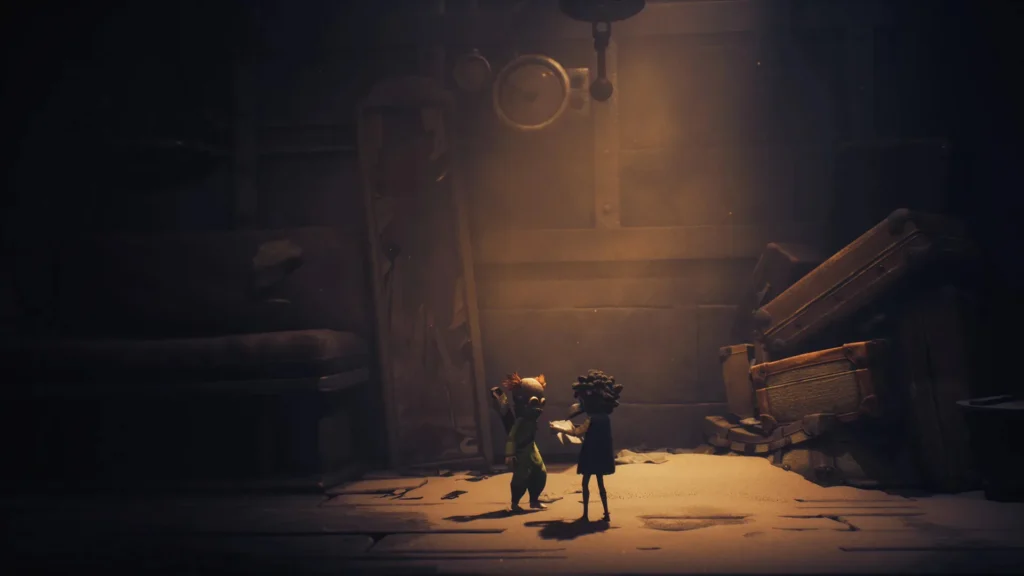
Our UE5 work has given us hands-on experience with exactly the systems UE6 is building on. That foundation is intentional. When UE6 tooling matures, we’ll be positioned to move fast.
What this means for publishers
Publishers have a slightly different stake in this announcement than the developers building the games. The concerns are commercial and timeline-driven: how does UE6 affect release schedules, licensing costs, and the competitive landscape of the games being funded?
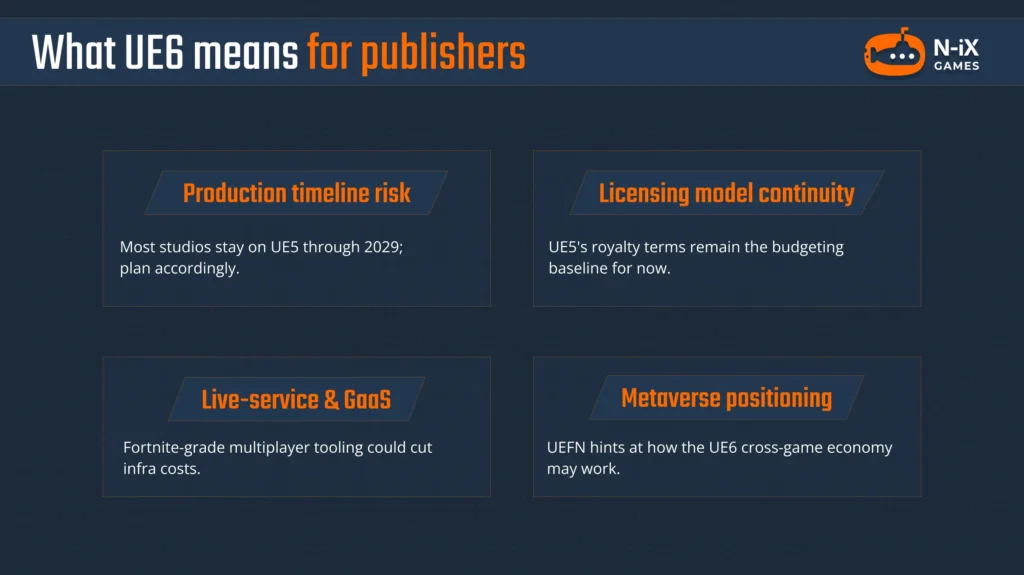
A few areas worth watching:
- Production timeline risk.
First UE6 commercial games are likely to ship in 2028 at earliest, with most major studios remaining on UE5 through 2029. Any project currently in production on UE5 is not affected. Projects still in pre-production with a 2028+ release target may face pressure from teams wanting to evaluate UE6 – that’s a conversation worth having early with your Unreal engine game development partner, not mid-production. - Licensing model continuity.
The current UE5 pricing model (5% royalty above $1 million lifetime gross) has not been announced as changing for UE6. Publishers financing development should treat current UE5 licensing as the baseline assumption for budgeting until Epic publishes UE6-specific terms. - Live-service and GaaS potential.
The Fortnite infrastructure flowing into UE6 is potentially a major cost-reducer for publishers funding live-service titles. If production-grade matchmaking, anti-cheat, and live deployment pipelines come as default tooling, the middleware and custom engineering budgets that currently go into multiplayer infrastructure could shrink. - Metaverse positioning.
If Epic’s cross-game economy vision materializes, it creates a new distribution and monetization layer for publishers whose games run on UE6. The details aren’t set in stone yet, but publishers with long-horizon IP investments should be paying attention to how Epic’s creator economy develops through UEFN. It’s the most visible prototype of what the UE6 cross-game layer might look like.
For publishers working with external Unreal Engine game development partners, the practical advice is to choose a studio that already has mature UE5 expertise and is actively tracking UE6 development, like N-iX Games. The transition, when it comes, will be smoother for teams that aren’t learning the engine from scratch at the same time as learning a new version of it.
N-iX Games works with publishers at every stage: from early-concept co-development to production support on shipping titles. Our UE track record spans over a decade of real projects across genres, and we are actively preparing for the UE6 transition so that our publishing partners don’t have to think about it.
FAQs
What is Unreal Engine 6?
Unreal Engine 6 is the next major version of Epic Games’ game engine, announced in May 2026. It is designed to unify the traditional Unreal Engine codebase with the Fortnite and UEFN tech stack, while adding full multithreading improvements, deeper AI tooling, and cross-game economy capabilities.
What will Unreal Engine 6 have?
Expected UE6 features include:
- Full multithreading;
- Verse scripting language integration;
- Scene Graph improvements for open-world streaming;
- UEFN convergence;
- Nanite v2 for animated meshes;
- Lumen 2.0 for global illumination;
- AI-assisted content authoring;
- Cross-game metaverse economy layer.
Most features are estimated, not yet officially confirmed.
What will Unreal Engine 6 look like?
The first visual demonstration showed Rocket League running on UE6, with a visible graphical upgrade over the current UE5-equivalent build. No full technical rendering breakdown has been published yet.
Which games use Unreal Engine 6?
Rocket League is the only confirmed UE6 title as of May 2026. It is the first partner game to be officially associated with the engine announcement. No other titles have been confirmed.
What Unreal Engine version should I use now?
Unreal Engine 5 is the current production-ready version and the right choice for any project starting today. UE6 has no preview build and no confirmed release date; practical production use is estimated for 2028 at the earliest.