Handing your game over to a team you’ve never worked with is an uncomfortable ask, and most studios come to game development outsourcing with the same worries already in mind: will the quality match what’s in your head, will you lose control of the direction, will a “final” quote turn into a much bigger invoice, and will your IP still be yours once the contract ends?
Those concerns are reasonable. They’re also largely solvable with the right process, and that’s what this guide walks through, based on the example of how the N-iX Games team handles the game development outsourcing process. It includes the cooperation models you can choose between, the six-step process from first call to launch, who owns what once the work is done, what it costs, and the risks worth planning for before you sign anything.
By the end, you’ll have clarity and confidence going into outsourcing, plus a checklist you can bring to your first scoping call instead of walking in blind.
Who this game development outsourcing guide is for
This isn’t written for publishers running twelve internal teams. It’s for the studios in between: teams that have shipped something, or are close to it, and now need help they can’t hire for fast enough.

- An indie team with a validated prototype that needs to scale production without doubling headcount.
- A publisher or studio bringing an existing title (indie or a bit larger) to a new platform, where the porting work needs specialized engine and certification experience nobody in-house has done before.
- A live-service team hitting a content or feature backlog that keeps growing faster than the internal roadmap can absorb.
- A studio whose art pipeline has become the bottleneck between “design is done” and “this is playable.”
If any of those sound familiar, the rest of this guide should save you a few expensive false starts.
Game development outsourcing models at a glance
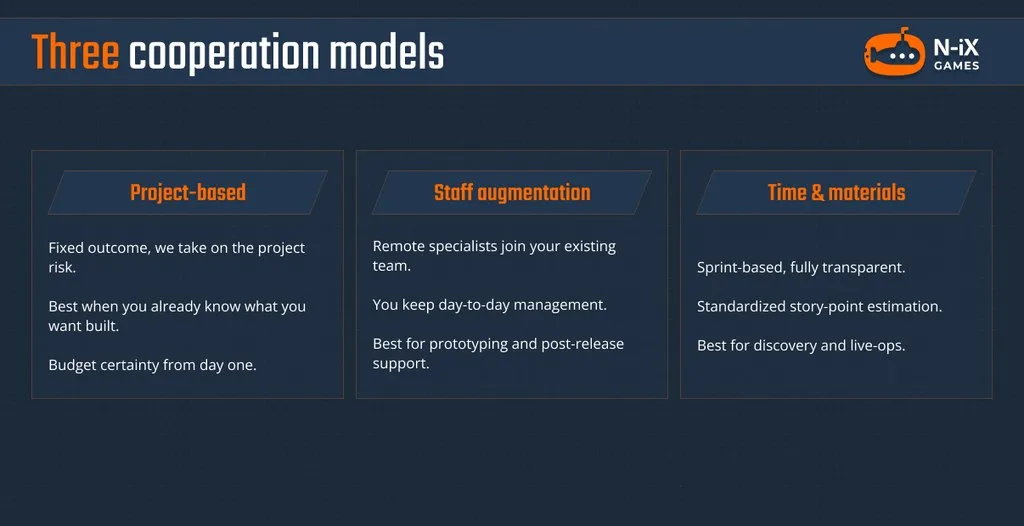
The first real decision when outsourcing game development is what kind of relationship you’re setting up. At N-iX Games, most engagements fall into one of three models, and the right one depends on how defined your scope already is and how much day-to-day control you want to keep.
1. Project-based model
Project-based partnerships work best when you already know what you want built. N-iX Games commits to a defined outcome, whether that’s a prototype, a vertical slice, or a finished asset pack, and the project risk shifts to us. You get budget certainty from day one, with room for managed change requests as the project moves forward.
2. Staff augmentation model
Staff augmentation puts remote programmers, artists, animators, designers, or QA specialists directly inside your existing team and processes, under your management. It fits rapid prototyping, active production, or post-release support such as bug fixes and DLC work, whenever you need tight alignment with an internal team rather than a separate one.
3. Time & materials model
Time and materials is a sprint-based, transparent model built around standardized velocity and story-point estimation. It suits discovery-led work, live operations, and anything where the scope is genuinely expected to shift as you learn.
Three cooperation models compared
| Model | Control you keep | Speed to start | Best for |
|---|---|---|---|
| Project-based | Lower day-to-day, high outcome certainty | Moderate (needs upfront scoping) | Defined deliverables: a prototype, a vertical slice, an asset pack |
| Staff augmentation | High, you manage the work directly | Fast | Filling skill or capacity gaps inside your own pipeline |
| Time and materials | Shared, sprint-by-sprint | Fast | Discovery, live-ops, and evolving scope |
Within any of these, the actual scope of work can range from a single discipline (art, animation, mocap, porting, or QA) up to full production.
Most studios don’t start with full-cycle development. And it’s completely understandable. According to insights from our own business development team, clients far more often order point services, a set of developers, UI/UX, a batch of 3D art, than a complete production partnership. Full-cycle engagements come around far less often, simply because assembling a large external team around someone else’s vision takes real coordination on both sides.
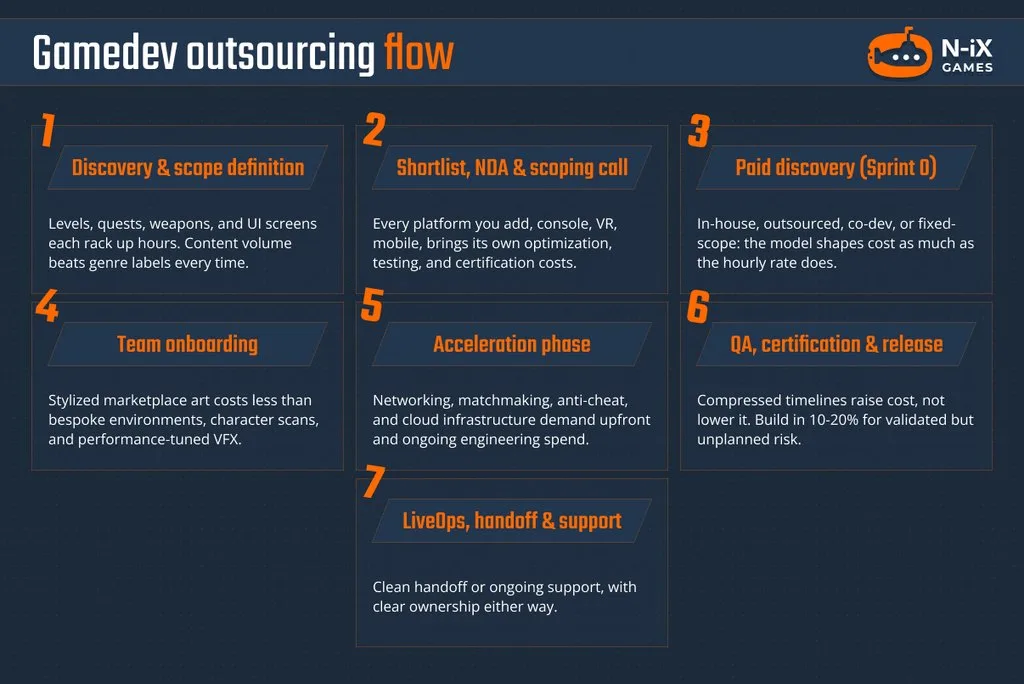
How game development outsourcing works, step by step
The process is linear, but each step exists to remove a specific kind of risk before it gets expensive to fix.
Step 1: Discovery and scope definition
This step turns a rough idea into something a studio can actually estimate: a problem statement, target platforms, KPIs, and a first pass at where ownership sits.
You: You bring a one-pager, references, target frame rate or level-of-detail expectations, your engine and version, and your must-have features.
Studio: The studio comes back with clarifying questions, an early risk log, and rough timeline bands rather than a final number.
A design document at this stage typically takes around three months to shape into something buildable, longer if it includes hands-on prototyping. You don’t need to arrive with one already written, either. That’s exactly what discovery is for: we at N-iX Games work from whatever you already have, even if that’s just a pitch and a few reference games, and help compile the details into something buildable based on what your project actually needs. But if you’ve already validated the core idea, you can often skip straight to pre-production instead.
Step 2: Shortlist, NDA, and scoping call
Before anyone talks numbers seriously, both sides need to confirm fit and confidentiality.
You: You’ll want an NDA in place, clear availability windows, and the actual decision-makers in the room.
Studio: In return, expect a capability deck, relevant case studies, and ballpark ranges by engagement model.
Step 3: Paid discovery, or Sprint 0
This is where the studio pressure-tests the plan before committing real production budget. In our own process, Sprint 0 runs about a week and covers project bootstrap:
- An Executive Producer locks in requirements, environment setup, and role alignment.
- A Technical Director analyzes the existing architecture and proposes an improvement plan if one is needed.
You should walk away with a production plan, a milestone map, a definition of done, and a sample deliverable that proves the pipeline actually works.
Step 4: Team onboarding and production sprints
Sprint 1 (roughly two weeks) is about staffing against the real project needs, building out the development plan, and identifying risks before they surface mid-production and become costly.
Step 5: Acceleration phase
From there, a two-month acceleration phase completes initial staffing and gets the team fully into production. Technical Director runs cross-team syncs across production, programming, design, and art. Expect a steady cadence from here: sprint goals, visible burndown, a weekly demo, and a fast feedback loop, often a 48-hour turnaround on client input as an industry-standard baseline (unless agreed otherwise).
Step 6: QA, certification, and release
Once builds stabilize, the focus shifts to test plans, bug triage, and getting through platform certification requirements.
You: You’ll need to provide test devices or accounts, store assets, and localization files
Studio: The studio handles the crash budget, performance targets, and a realistic submission timeline.
This is also where release-strategy decisions start to matter as much as the build itself. For example, discoverability on console storefronts is often worse than teams expect going in, and platform holders can delay a release by months if certification issues surface late, which is exactly why this step shouldn’t be rushed, our teams say.
Step 7: LiveOps, handoff, and post-launch support
A clean handoff includes documentation, final builds, source assets, and knowledge-transfer sessions, plus a clear SLA for critical bugs if you’re keeping a support retainer. Whether you keep the studio on for live content or bring everything back in-house, ownership needs to be explicit here.
We at N-iX Games have been supporting our long-term partners like Wargaming, Paradox, and Supermassive Games post-launch with various projects and new releases, some of them for years past the original ship date, which tends to say more about a partnership than anything in the pitch deck. For instance, the art for World of Tanks Blitz for Wargaming, new titles within the Dark Pictures Anthology: The Devil in Me, Switchback VR, House of Ashes for Supermassive Games, and other projects.
What to prepare before your first call
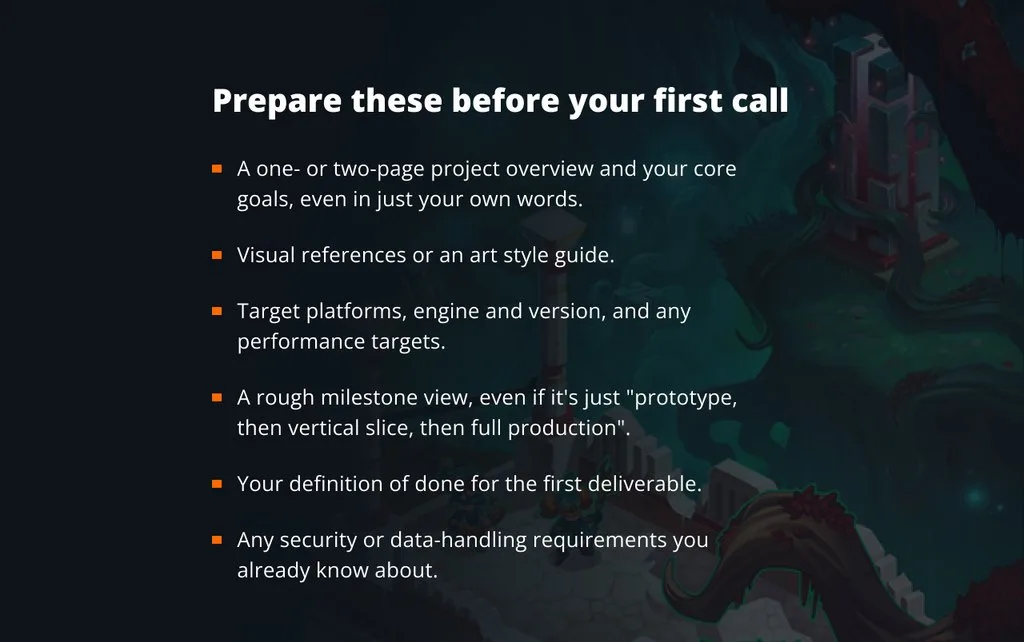
You don’t need a 40-page design bible to start this conversation, but showing up with the following speeds everything up and helps the studio give you a realistic range instead of a guess:
Milestones, acceptance criteria, and change control
An industry’s typical milestone map can look like this: discovery, vertical slice, alpha, beta, certification, launch. They can differ per studio, but the core is usually the same.
Acceptance criteria should be concrete before a milestone starts: a performance threshold (say, a locked frame rate on target hardware), art-spec compliance against the style guide, and a maximum bug-severity count to close out a milestone. Change control matters just as much. Scope changes should be logged, estimated against the current sprint capacity, and scheduled rather than absorbed silently, because silent scope creep is where budgets and timelines both quietly break.
Game development outsourcing cost: Realistic ranges & what drives them
Remember this: There’s no single number here, and any studio that gives you one without asking about scope first is guessing.
What we can offer is the range of planning scenarios that actually hold up, based on our own Unity and Unreal Engine cost breakdowns.
A brief scope/price breakdown
| Scope | Typical team | Timeline | Indicative budget |
|---|---|---|---|
| Prototype / proof of concept | 1 designer + 1 developer | 1–3 months | $20,000–$40,000+ |
| Vertical slice | Small multidisciplinary team | 3–6 months | $50,000–$150,000+ |
| Commercial indie game | 10–20 specialists | 6–24 months | $150,000–$1,000,000+ |
| AA production | 20–50 professionals | 1–3 years | $1,000,000–$20,000,000+ |
Please keep in mind that this is generic information just to help you get a sense of scale before a real conversation about your specific game. The budget is also influenced by the amount of content, your target platforms and their number, 2D or 3D art included, whether you want just a roster of 2D characters or a set of 3D environments, and so on. Treat these ranges just as a starting point.
Examples based on our projects
Full-cycle projects at the larger end of that range routinely run from the low hundreds of thousands into the tens of millions, and the single biggest driver of where a project lands isn’t genre or engine. It’s uncertainty. Our game Speed Crew, a tightly scoped party game inspired by a proven formula similar to Overcooked, was built on a predictable budget precisely because it leaned on an already-validated mechanic instead of an untested one. That’s a fundamentally different bet than pursuing a concept that keeps changing mid-production.
Another project we’ve supported went well above its original budget, largely because the concept kept shifting throughout development. Matching a client’s actual financial capacity to their creative ambitions early is one of the most valuable things a discovery phase does.
That is, here are common budget leaks worth watching for:
- An unclear definition of done;
- Feedback that arrives late in the sprint cycle;
- Engine upgrades introduced mid-stream;
- Large scope changes requested without a change-control process in place.
47% of studios report unsatisfying outsourcing partnerships, citing poor quality, not price, as the primary reason. Prioritize thorough scoping over squeezing hourly rates.
IP, security, and ownership in game development outsourcing
Before any confidential material changes hands, an NDA should already be signed. Beyond that, three things are worth confirming explicitly rather than assuming:
- Who holds IP ownership on custom-built assets and code?
- Who has source-control access and at what permission level?
- How is player or player-adjacent data protected if the project touches live services?
N-iX Games follows ISO-aligned information security practices and vets every specialist before they join a client project.
Risks in game development outsourcing and how to mitigate them
- Quality drift. A studio that looked great in the pitch deck can still miss your bar in practice. A paid Sprint 0 exists specifically to catch this before the full production budget is committed.
- Missed dates. Milestone-based payments tied to a fixed definition of done keep both sides honest about what “on schedule” actually means.
- Hidden costs. A locked scope document and a documented change-control process turn “surprise invoice” into “logged and priced change request.”
- Communication gaps. Weekly demos and a defined feedback SLA close the loop faster than monthly status emails ever will. In one industry survey, poor communication was the second most common reason studios reported an unsatisfying outsourcing partnership, right behind service quality itself.
- Security. Access controls, NDAs, and vendor vetting aren’t paperwork for its own sake. They’re what keeps an unreleased build from ending up somewhere it shouldn’t.
There’s a quieter risk worth naming too, especially for indie partnerships: outsourced teams working purely to spec can lose the instinct to suggest a better idea when they see one. That’s why the best partnerships tend to form with vendors whose teams work both on outsourced projects and their own original products.
We build our own games too. Our team also stays genuinely invested in every project that comes through the door, whether it’s an indie gem or a AAA behemoth, bringing those creative sparks along. That’s a big part of why so many of our partners keep coming back to make a new game with us, instead of moving on once a single contract wraps.
Are you ready to outsource game development?
Game development outsourcing works best when it’s planned like a production phase. N-iX Games covers the whole range, from a single art pass to full-cycle production and everything in between, so you don’t need to know yet how much you want to hand off. A first conversation doesn’t commit you to anything; it’s just a chance to get a second set of eyes on your scope before any numbers come up. Let’s talk!
FAQs
How long does game development outsourcing take?
It depends entirely on scope, but a paid discovery or Sprint 0 phase typically runs about a week, followed by a two-week onboarding sprint and roughly two months to reach full production pace. From there, production sprints run continuously until the milestone map is complete.
Can you work in our engine and version?
Yes. Outsourcing partners with real production depth typically support current and recent versions of both Unity and Unreal Engine, along with the certification requirements for major console and mobile platforms. Confirm your exact engine version during Step 1, since a mismatch there is one of the easiest things to catch early and one of the most expensive to discover late.
What if we need to scale mid-project?
This is exactly what our staff augmentation and time-and-materials models are built for. As a studio with an established bench, we can add specialists within days rather than the months a new in-house hire usually takes, without needing to renegotiate the entire engagement.
Do you sign NDAs?
Yes, and this should happen before any confidential material, including early builds, design documents, or art references, is shared in either direction. This is one of the first things to settle whenever outsourcing game development moves from a conversation to something real.
How do you handle time zones?
Structured overlap windows, asynchronous documentation, and a fixed feedback SLA matter more than raw geographic proximity for us. We have mature remote-collaboration habits and can work well across a wide time-zone spread; a studio without them will struggle even with a single hour of difference.