Every producer eventually asks the same question before greenlighting an Unreal project: What will this actually cost? It rarely has one answer.
Unreal game development cost swings from tens of thousands of dollars for a lean prototype to multi-million-dollar budgets for a cross-platform, live-service title, and the engine itself has almost nothing to do with that spread. What separates a $60,000 build from a $2 million one is scope, content volume, and the team behind it.
In this article, we’ll take a detailed look at game development cost estimation for games built with Unreal Engine. This way, you’ll know exactly what you’re paying for before you commit to a number.
Unreal game development cost: what the ranges actually look like
A tightly scoped PC prototype or a small premium title built in Unreal typically lands around $50,000, while a content-heavy, multiplayer, cross-platform production can run into several million. The engine is rarely the main cost driver here. What actually fills that range is a short list of line items:
- Team time across design, engineering, art, and production
- Original content: environments, characters, animation, VFX, audio
- Platform certification and compliance work
- Online systems and backend infrastructure, where applicable
- QA passes across the target platforms
- Post-launch support and content updates
Industry estimates for smaller-scope Unreal titles vary depending on team location and project definition, with some studios quoting figures as low as $20,000 for a narrowly defined build and others citing AAA-level Unreal productions reaching $1 million to $10 million or more. Treat any single number with caution until scope is defined. The table below reflects planning scenarios rather than industry averages, and your actual quote depends on the assumptions your team locks in before production starts.
| Scenario | Typical scope assumption | Indicative production budget |
|---|---|---|
| Prototype / vertical slice | One polished core loop, one environment, PC target | 30,000-150,000 |
| Small premium game | 3D single-player, stylized visuals, PC launch | 100,000-500,000 |
| Mid-scope PC/console game | Custom art, deeper systems, multiple content areas | 500,000-2 million+ |
| Multiplayer or live-service title | Backend, online features, content cadence, live support | $1 million+ |
| AAA-scale production | Large content pipeline, cinematic production, multi-platform release | Multi-million-dollar budget |
From our business development team: Prototyping tends to sit at the cheaper end of these ranges. Since a lot of early gameplay work can be built entirely in Blueprints, teams can validate a core loop without writing full C++ systems yet, which keeps the vertical-slice stage lighter on both time and budget.
Unreal Engine’s royalty model vs. your actual production budget
Confusing engine fees with production costs is one of the most common mistakes we see in early planning conversations, so it’s worth separating the two clearly.
Unreal Engine is free to start building with, and it stays free for internal projects, learning, and most client work. The cost that shows up later is a royalty, and its terms break down into a few fixed points:
- Engine access: Free to download and use for development, prototyping, and most client work.
- Standard royalty: Under the standard end user license agreement, Epic Games collects a 5% royalty on a game’s worldwide gross revenue once it passes the first $1 million in lifetime earnings, with no charge on that first million at all.
- Reduced rate: Studios that release simultaneously on the Epic Games Store under the Launch Everywhere with Epic program qualify for a reduced 3.5% rate instead of the standard 5%.
Example: A title earning $1.5 million in qualifying lifetime revenue under the standard structure owes its 5% royalty only on the $500,000 above the $1 million threshold.
That royalty is a rounding error compared to what actually fills a production budget. The real spend goes toward:
- People: designers, engineers, artists, audio staff, and QA
- Original content and hardware
- Plugins and middleware
- Platform certification and localization
- Backend infrastructure and everything else involved in getting a build ready to ship
When a client asks us about Unreal Engine outsourcing cost, this is the distinction we walk through first, because the royalty rarely moves the needle on a pre-launch budget at all.
Six factors that change your Unreal game development cost estimation
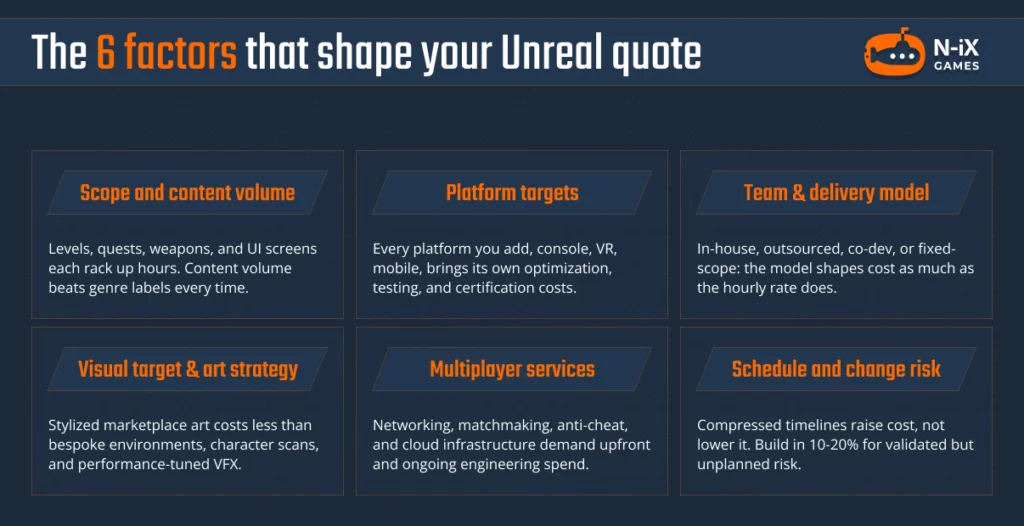
Two studios can describe their game as a mid-scope Unreal PC title and land a hundred thousand dollars apart on the quote. The gap almost always comes down to these six variables.
1. Scope and content volume
Levels, playable characters, weapons, quests, cinematics, UI screens, and game modes each carry their own production hours. Content volume, not a label like “indie” or “AAA,” is what drives the estimate.
2. Visual target and asset strategy
Stylized, modular art that leans on marketplace assets costs less than bespoke realistic environments, character scans, and performance-tuned VFX. UE5’s toolset, including Nanite and Lumen, can speed up parts of the pipeline, but it doesn’t remove the content, optimization, or technical-art work behind a polished look.
3. Platform and performance targets
A PC-only release is a different budget than PC plus console, VR, or mobile, for example. So, every additional platform adds optimization passes, input and controller work, device-specific testing, and in some cases certification requirements from the platform holder.
We generally don’t recommend Unreal Engine for mobile-only titles. It’s built first and foremost as a console and PC engine, and putting it behind a mobile game usually means paying for graphical horsepower and systems the device can’t fully display, so a chunk of the budget goes toward potential the platform can’t show off.
4. Multiplayer and backend services
Authoritative networking, matchmaking, account systems, persistence, anti-cheat, telemetry, and cloud infrastructure all require upfront engineering and ongoing operational spend. This is one of the biggest reasons live-service titles carry a fundamentally different budget profile than single-player releases. Really bigger budgets!
5. Team seniority and delivery model
In-house teams, dedicated outsourced teams, co-development partnerships, and fixed-scope engagements all price differently. Hourly rate is only one variable in that comparison; throughput, rework risk, communication overhead, and how much technical ownership a partner actually takes on matter just as much.
As a simple rule of thumb, Unreal projects usually come in 20–30% more expensive than teams initially expect, mainly because of the salary expectations of experienced Unreal developers, who are a smaller and more specialized talent pool than engineers on other engines, like Unity.
6. Schedule and change risk
Compressing a timeline usually raises cost rather than lowering it, since parallel work and overtime both carry a premium. Most experienced teams reserve 10–20% of the budget for validated but unplanned risk, with the exact figure depending on how mature the project scope already is.
How to build a realistic Unreal Engine game development cost estimate
A dependable estimate comes from breaking the concept into production units before anyone attaches a dollar figure to it. Here’s the sequence we walk clients through.
Step 1: Define the release target. Lock in platforms, game mode, camera perspective, monetization approach, performance objective, localization needs, and multiplayer assumptions before anything else.
Step 2: Turn the concept into production units. Convert the pitch into countable items: environments, characters, weapons, cinematics, UI flows, enemy types, progression systems, and online features.
Step 3: Estimate effort by discipline. Each discipline owns a distinct slice of the work, and estimating them separately catches gaps a single blended number would miss.
| Discipline | Typical responsibilities |
|---|---|
| Design | Core loop, systems, levels, economy, documentation |
| Engineering | Gameplay, UI, AI, tools, optimization, online integration |
| Art and technical art | Characters, environments, materials, rigging, VFX, lighting |
| Audio | SFX, music, voice, implementation |
| QA | Functional, compatibility, regression, certification support |
| Production | Planning, risk tracking, vendor coordination, reviews |
Step 4: Apply a blended team rate. Development budget equals estimated production hours multiplied by a blended hourly rate across disciplines. From there, total launch budget adds external services, contingency, and launch preparation on top of that development number.
Step 5: Add lifecycle costs separately. Servers, patches, ongoing support, new content drops, community management, and user acquisition belong in a post-launch budget line, not folded into the initial build estimate.
How to control cost without cutting quality
Cost discipline and quality aren’t opposites when the sequencing is right.
- Fund a pre-production discovery phase before committing to full production, so assumptions get tested while they’re still cheap to change.
- Build a vertical slice that validates gameplay, art direction, performance, and pipeline together, not just how a trailer might look.
- Define a “must ship” feature set early and put real change-control rules around anything added later.
- Reuse modular content wherever it doesn’t damage the player experience.
- Bring in external specialists for bounded, high-skill work, such as console optimization, network architecture, VFX, or cinematics, rather than staffing permanently for occasional needs.
- Plan QA and performance passes from the first playable build instead of pushing them to the end.
- Request vendor estimates on comparable terms: same platform targets, same content assumptions, same acceptance criteria, same post-launch scope.
Need a budget grounded in your actual scope? Share your target platforms, core loop, multiplayer requirements, visual references, and planned content volume with us, and our N-iX Games team will come back to you promptly with a detailed quote.
With over 10 years of experience in Unreal Engine game development, we’ve shipped titles across every genre, from horror and strategy to action and simulation, and every size, from indie projects to AA and AAA productions. We start with an idea analysis and a quote, then carry the project through design, development, production, release, and post-launch support.

FAQ
How much does it typically cost to develop a game using Unreal Engine?
Most Unreal projects fall somewhere between $50,000 for a small, tightly scoped release and several million dollars for a large multiplayer or cross-platform production. The number depends far more on content volume, platform targets, and team model than on the engine itself.
What are the main cost factors involved in Unreal Engine game development?
Scope and content volume, visual and asset strategy, platform and performance targets, multiplayer and backend requirements, team seniority and delivery model, and schedule pressure are the six variables that consistently move a quote up or down.