An MMORPG backend has to do a lot at once. It absorbs sudden spikes in concurrent players, keeps world state and player progress in sync in real time, runs matchmaking, and stays available across regions without players noticing a hiccup. AWS gives teams a flexible foundation for that kind of scale, from dedicated game server hosting to serverless services built for bursty workloads.
So, what’s this article for? Here, our experts will walk you through practical patterns for an AWS game backend, along with the moments where an experienced engineering partner tends to make implementation smoother.
What a scalable MMORPG backend architecture needs
Before picking services, it helps to define what the backend actually has to do.
MMORPG development teams generally need six things working together, and each one shapes a different part of the AWS architecture.
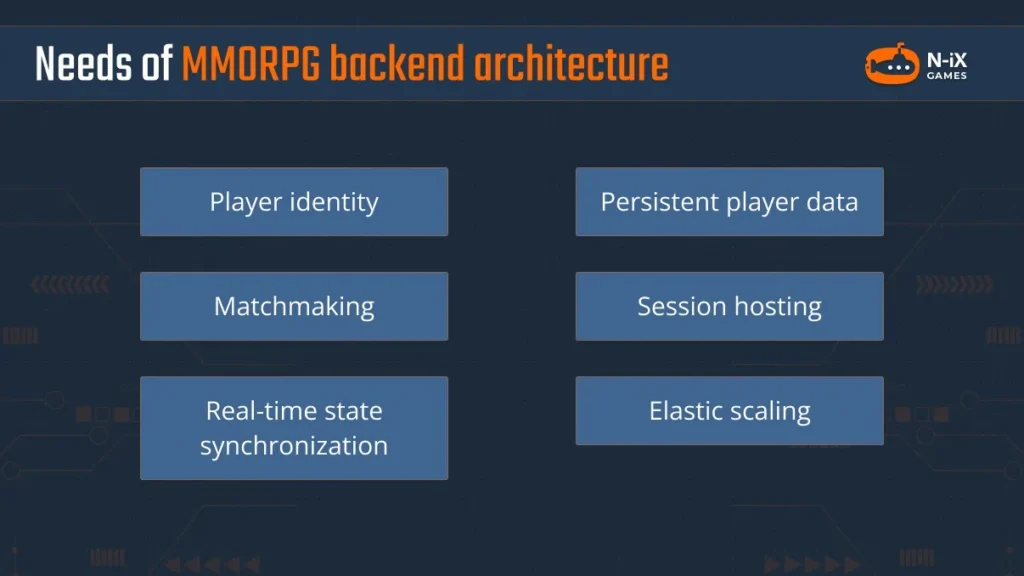
Six core needs:
- Player identity. Nothing else works without knowing who a player is and what they own.
- Persistent player data. Inventory, progression, and currency need to persist reliably, even during peak load or a server restart.
- Matchmaking. Players get grouped into sessions based on skill, party size, or region, and this has to keep working smoothly during a launch-week surge.
- Session hosting. Players are placed into a running game instance with low enough latency that combat and movement feel responsive.
- Real-time state synchronization. Every connected client needs to see a consistent version of the world.
- Elastic scaling. Capacity has to grow when players show up and shrink again when they leave, or costs creep up for no reason.
Why can’t these be solved in isolation?
None of these are separate problems. A matchmaking service that doesn’t talk to session hosting will place players into servers that don’t exist yet. A player data store that isn’t decoupled from game logic becomes a bottleneck the moment a content update needs redeploying.
That’s why AWS documentation on online multiplayer architecture and serverless-based backend design treats these as one connected system rather than a checklist. Getting the architecture modular from day one is what lets an MMORPG grow from a closed beta to a live service without a rewrite.
AWS building blocks for a modern game backend
AWS isn’t a single product for game backends. It’s closer to a toolkit, and the services worth knowing fall into three groups: session hosting, serverless application logic, and data persistence.
1. Session hosting: Amazon GameLift
Amazon GameLift is the piece built specifically for session-based multiplayer. It deploys, scales, and manages the actual game server processes, so a studio isn’t left writing its own fleet management from scratch. Key points:
- GameLift’s FlexMatch handles skill-based matchmaking and can place players into sessions across multiple regions, which matters for latency-sensitive combat in an MMORPG.
- AWS’s own game backend documentation notes that its global infrastructure spans 31 Regions, 99 Availability Zones, and 33 Local Zones, giving teams a wide set of options for where to place game servers relative to their player base.
2. Serverless application logic
Serverless services cover the parts of the backend that don’t need a persistent connection: login, inventory checks, quest state, notifications, leaderboards.
- AWS Lambda runs this logic on demand.
- API Gateway exposes it as REST or WebSocket endpoints.
- Amazon Cognito handles authentication.
This combination is well documented in AWS’s serverless multiplayer game reference architecture, which breaks a single- and multi-player trivia game down into exactly this kind of service split.
3. Data persistence
Data persistence for an MMORPG usually means Amazon DynamoDB for high-throughput player and world data, sometimes paired with Amazon ElastiCache for Redis where leaderboards or live scoreboards need sub-millisecond reads. The AWS Well-Architected games industry lens recommends separate data stores per feature rather than one shared database, which keeps teams from stepping on each other’s schema changes.
A studio building MMORPG development pipelines typically ends up combining all three groups rather than picking one: GameLift for combat sessions, Lambda-based services for account and inventory systems, and DynamoDB or Redis depending on how fast a given read needs to be. The pairing matters more than any single service choice.
Session hosting and orchestration with Amazon GameLift
Session hosting is where most of the latency budget lives, so it deserves its own layer rather than being bolted onto general-purpose compute. GameLift and FlexMatch split this work cleanly: one hosts the game, the other decides who plays together.
What GameLift handles
GameLift deploys game server builds across fleets that can span multiple regions and manages the lifecycle of each server process, from starting it, to placing a session on it, to recycling it once the session ends. A queue routes each new session to whichever fleet location has spare capacity and acceptable latency for that player, which is what makes global hosting possible without standing up a separate stack per region.
What FlexMatch handles
FlexMatch is the matchmaking layer that decides who ends up in those sessions together. AWS’s walkthrough of GameLift and serverless integration describes a rule set with a graceful fallback: players are grouped by skill with a latency requirement of under 50 milliseconds, and if a match hasn’t formed after ten seconds, that requirement relaxes to 200 milliseconds. This keeps queue times reasonable without dumping players into a badly matched game, and it hands off the finished match to GameLift for placement.
Identity plays a supporting role here too: session placement typically checks a signed token from the authentication service before a player can join, which keeps unauthenticated clients from occupying game server capacity that paying, verified players need.
Where serverless fits in an AWS game backend
Not every part of an MMORPG needs a dedicated server. Login flows, inventory lookups, quest progression, notifications, and leaderboards are bursty rather than continuous. They spike during events and go quiet the rest of the time, which is exactly the workload pattern serverless computing was built for.
The core services in a serverless layer
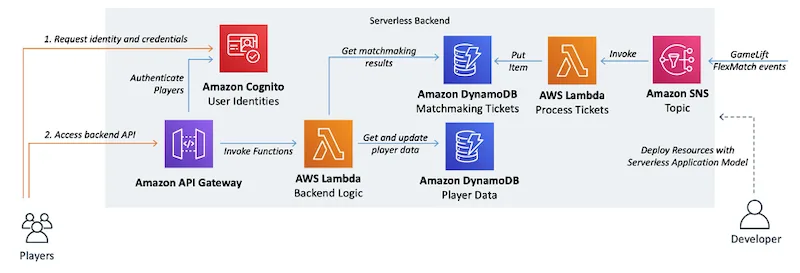
AWS’s reference architecture for a serverless multiplayer game lays out a working pattern that generalizes well to MMORPGs:
- AWS Lambda runs each feature as its own function, so a leaderboard update and a login check scale independently of each other.
- Amazon API Gateway exposes these functions over HTTP or WebSockets, depending on whether the feature needs a persistent connection.
- Amazon DynamoDB stores player and game state per feature, which limits the blast radius if one table needs a schema change.
- Amazon SNS decouples write-heavy events, like a completed quest, from the services that react to them, such as leaderboard updates and player progress tracking.
- Amazon Cognito issues and validates the tokens every one of these services checks before doing any work.
Where Redis fits in
The Well-Architected games industry lens adds that VPC-enabled Lambda functions can reach ElastiCache for Redis when a feature, like a live leaderboard, needs faster reads than DynamoDB alone provides.
Why this matters beyond cost
The advantage for MMORPG development teams isn’t just cost. It’s that a small team can ship and iterate on account features, events, and progression systems without maintaining a second server fleet solely for logic that doesn’t need one.
Cross-platform identity and player access
Players expect to log into an MMORPG on one device, pick it up on another, and see their character exactly where they left it. That expectation puts real weight on the identity layer, which has to be secure enough to prevent account takeover and flexible enough to support whichever platforms a studio ships on.
What AWS’s cross-platform identity guidance covers
AWS addressed this directly with its Guidance for Custom Game Backend Hosting on AWS, a framework that ships with:
- A cross-platform identity component supporting Facebook, Google Play, Sign in with Apple, and Steam.
- Anonymous guest accounts that can later be linked to a real identity.
- Support across Unreal Engine 5, Unity 2021 and later, and Godot 4, plus a REST API for any custom engine.
Why account linking matters for MMORPGs
The practical benefit for MMORPG development is account linking: a player can start as a guest, add a platform login later, and keep the same progression either way. Behind the scenes, this identity component rotates its signing keys automatically and logs every request through CloudWatch and X-Ray, so a studio isn’t flying blind on authentication traffic once it’s live.
Backend decisions here reach further than security. An identity system that makes cross-device play awkward is one of the quieter reasons players drop off after a first session.
Architecture patterns that hold up at scale
The building blocks mentioned above only pay off if they’re assembled with a few structural principles in mind. Each one affects a different failure point: deployment, response time, cost, or uptime.
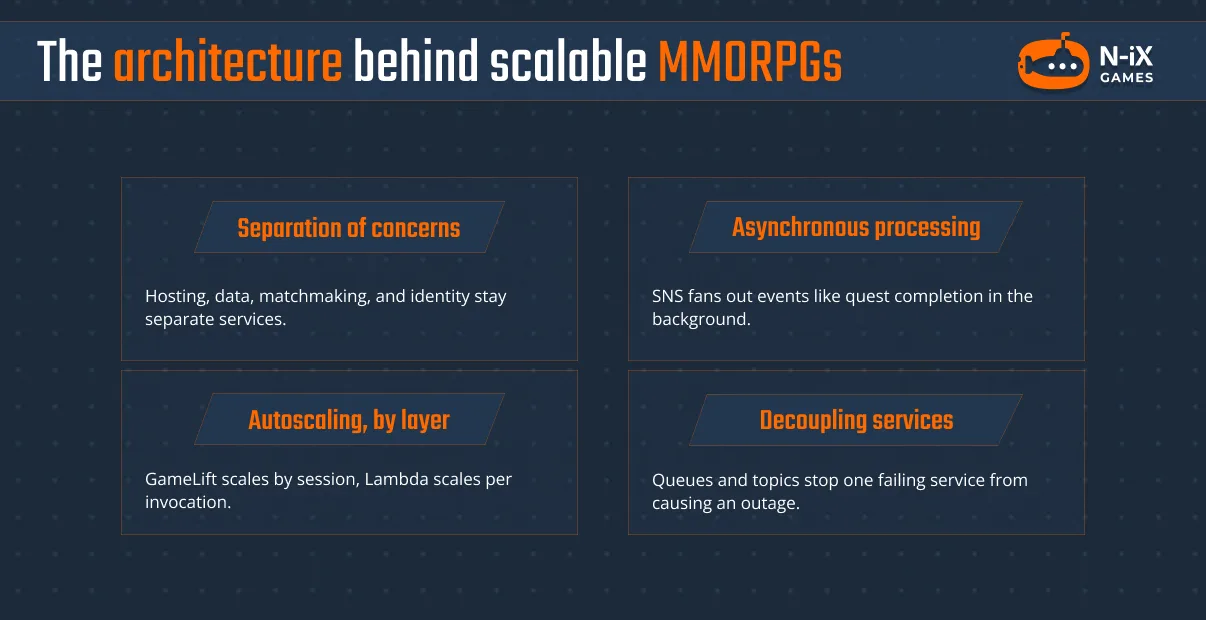
1. Separation of concerns affects deployment risk
Keeping session hosting, player data, matchmaking, and identity as distinct services means a studio can push an inventory update without redeploying the combat servers. The practical payoff shows up during live-service updates: a bad release to one feature doesn’t force a rollback across the whole backend.
2. Asynchronous processing affects response time
Anything that doesn’t need an instant reply should run fire-and-forget. The serverless reference architecture uses Amazon SNS to fan out events like a completed quest to leaderboard and progression services, so a slow write to one of those systems never delays the response the player actually sees.
3. Autoscaling by layer affects cost and ops load
GameLift fleets scale server capacity based on active sessions, while Lambda functions scale per invocation. Because the trigger differs by layer, neither one needs a person watching a dashboard to add capacity before a weekend spike, and neither gets billed for idle capacity it isn’t using.
4. Decoupling services affects failure isolation
Routing events through queues and topics rather than calling services directly means a failing leaderboard write queues up instead of taking down the quest system that triggered it. AWS’s scalable game development patterns whitepaper treats this kind of loose coupling as a baseline requirement, not an optimization to add later.
Choosing the right AWS service for the job
| Workload | Best-fit AWS service | Why |
|---|---|---|
| Real-time combat sessions | Amazon GameLift | Manages server lifecycle and low-latency placement |
| Bursty backend logic (login, inventory, quests) | AWS Lambda + API Gateway | Scales per invocation, no idle server cost |
| High-throughput player/world data | Amazon DynamoDB | Purpose-built for microservice-scale reads and writes |
| Sub-millisecond reads (live leaderboards) | Amazon ElastiCache for Redis | Faster than DynamoDB alone for this pattern |
Common pitfalls in MMORPG backend development
A few mistakes show up often enough in MMORPG backend projects that they’re worth naming directly.
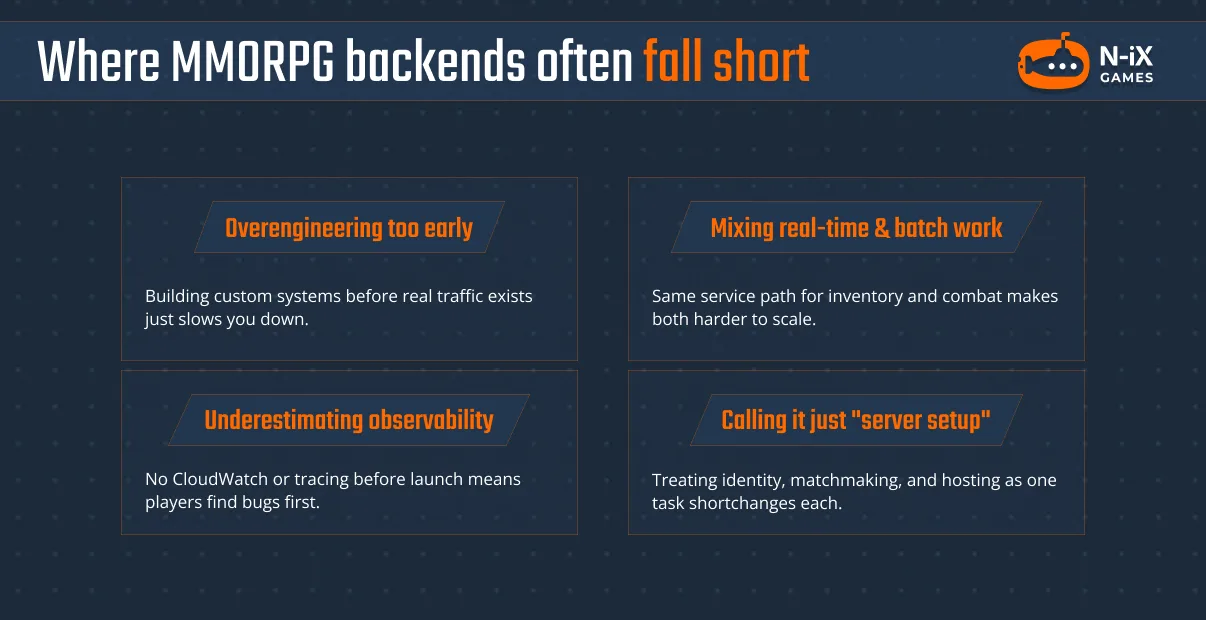
- Overengineering too early. Building a custom matchmaking system or a bespoke session orchestrator before there’s real player traffic to justify it slows a team down without proving anything.
- Mixing real-time and non-real-time workloads. Running inventory checks and combat state through the same service path makes both harder to scale independently, and it’s the exact split the serverless and GameLift reference architectures are built to avoid.
- Underestimating observability. A backend without CloudWatch metrics and distributed tracing in place before launch means a studio finds out about a scaling problem from player complaints instead of a dashboard.
- Treating backend work as just “server setup.” Session hosting, identity, matchmaking, and persistence are each a real engineering discipline, and treating the whole thing as a single infrastructure task usually means one of them gets shortchanged.
These aren’t AWS-specific problems. They show up on any cloud, but they’re avoidable with the right sequencing, and that’s usually where teams that have shipped a live-service MMORPG before have an edge over a team doing it the first time.
Why a development partner matters for AWS game backend projects
This is where a partner like N-iX Games tends to add the most value. N-iX Games has worked as a long-term co-development partner for studios including Paradox Interactive, on titles such as Victoria 3, Stellaris, and Crusader Kings III, and Supermassive Games, studios that also build MMORPGs and other large-scale multiplayer titles, alongside cloud solutions work across a range of projects.
For a studio that wants its internal team focused on combat feel, world content, and progression systems rather than backend plumbing, bringing in a partner for architecture decisions, implementation, and production readiness is often the difference between a backend that survives a launch spike and one that needs an emergency patch during it.
Turn AWS into a production-ready MMORPG backend
AWS gives MMORPG developers a genuinely wide toolkit for scalable multiplayer backends: GameLift for session hosting, serverless services for everything bursty, and a set of data and identity services built for exactly this kind of workload.
None of that replaces the real work of designing the right architecture for a specific game. The services matter less than the decisions about how they fit together, and those decisions are easier to get right with a team that has made them before.
Need help turning AWS capabilities into a reliable MMORPG backend? N-iX Games can support your team with the architecture decisions, implementation, and scaling work needed to get there.