Getting a game to run well on a different platform than it was built for is genuinely hard work. The code behaves differently, the hardware has its own constraints, and every platform holder has its own certification process waiting at the finish line.
This guide rounds up 8 of the best game porting companies in 2026, with real portfolios, verified ratings, and clear “best for” profiles, so you can find the right partner without wasting weeks on research.
The studios listed here are mid-sized specialists – experienced, certified, and with strong client track records. If you’re an indie, AA, upcoming AAA, or growing studio looking for a focused porting partner that will actually know your project without tying you to an enterprise-level budget, this is the list for you.
Why outsource game porting?
Game porting outsourcing has gone from a convenience to a standard industry practice, and the numbers reflect it.
According to Verified Market Reports, the global game porting services market was valued at $1.2 billion in 2024 and is projected to reach $3.5 billion by 2033, growing at a 12.5% CAGR.
That growth isn’t coming from nowhere. It’s driven by a simple reality: players now expect the same experience on every device they own.
There are three main reasons studios reach out to specialized game porting companies rather than handling it in-house:
- The technical expertise required to navigate platform-specific SDKs, memory budgets, and controller schemes takes years to build.
- Porting is time-intensive work that pulls engineering resources away from your next project or your live title’s update pipeline.
- Console certification is its own discipline. A studio that hasn’t shipped on PlayStation or Nintendo Switch before will spend weeks learning what an experienced partner handles in days.
Put simply, outsourcing porting games to a dedicated studio usually means faster timelines, lower risk of certification failure, and a final product that behaves like it was built for that platform from the start.
Top-ranked video game porting companies in 2026
The companies below were selected based on verified client feedback, publicly documented porting credits, platform breadth, and demonstrated technical depth.
1. N-iX Games
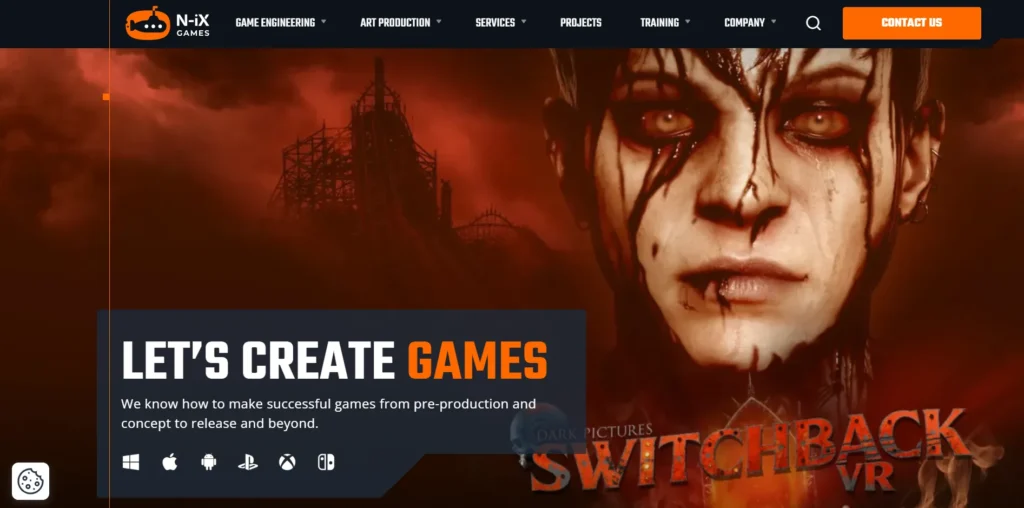
Founded in 2012, N-iX Games is a full-cycle game development company with 200+ specialists across Ukraine. They offer platform porting services alongside co-development, VR, and console game development. The team holds all necessary platform SDKs and certifications, covering everything from generation-to-generation upgrades to engine migrations and VR porting.
Their notable clients for game development are Supermassive Games, Paradox Interactive, Ubisoft, Blizzard Entertainment, CI Games, Netflix, and others. Featured ported titles include Speed Crew (from Nintendo Switch to PlayStation, Xbox, and Steam) and others.
Best for:
- PC (Windows, macOS) ↔ console porting
- PS4/PS5, Xbox One/Series, Nintendo Switch ports
- VR platform porting (Oculus Quest, Vive, HoloLens, and others)
- Android, iOS, Fire OS mobile ports
- Engine-to-engine migration (Unity ↔ Unreal Engine)
- Generation-to-generation upgrades and downgrades
Rating:
Clutch: 5.0/5
2. Kevuru Games
Kevuru Games is a European game art and development studio with 250+ specialists and over 10 years in the industry. They offer game porting services across PC, console, and mobile, alongside a broader suite of art production and full-cycle development.
Their client list includes Epic Games, Lucasfilm (Star Wars), and top-20 global publishers, though no ported titles are showcased publicly.
Best for:
- PC (Windows, macOS) porting
- Console ports to PS4/PS5, Xbox One/Series, Nintendo Switch
- Mobile ports to iOS and Android
- Projects that combine porting with 3D art production or animation
Rating:
Clutch: 5.0/5
3. iLogos Game Studios

iLogos is a game development and art production studio founded in 2007, with 18 years of experience and 460+ completed projects for clients including Ubisoft, EA, Disney, Supercell, and Zynga. The studio runs a dedicated porting division alongside its engineering, art production, and LiveOps teams.
Their porting team has handled mobile platform ports for the web3 title Gods Unchained and other projects.
Best for:
- Mobile game porting (iOS, Android, Facebook/web platforms)
- PC and console port support with accompanying art production
- Studios looking to combine porting with live-ops or ongoing maintenance
Rating:
GoodFirms: 5.0/5 | Clutch: 5.0/5
4. Room8 Studio

Room8 Studio is an international game development and art production company founded in 2011, with 1,100+ specialists across Europe and the Americas. The studio works with 7 of the top 10 global publishers, including Microsoft, Nintendo, Ubisoft, Sony, EA, and Activision. Beyond the technical side of porting, Room8 offers content adaptation and UX/UI redesign.
One strong game porting outsourcing example: their Switch port of ABZÛ, a game built on custom rendering technology originally designed for higher-end hardware.
Best for:
- Console and mobile ports requiring content adaptation or UX transformation
- Co-development projects alongside porting work
- Publishers needing a studio with AAA co-development credentials
Rating:
G2 profile available – enterprise-level; request ratings on inquiry.
5. Independent Arts Software (Astragon Development)

Independent Arts Software has been active in game porting since the 1990s. Their longevity speaks for itself: all three major platform holders – Microsoft, Nintendo, and Sony – have called on Independent Arts as a trusted partner.
This level of cross-platform trust from first-party companies is rare, and reflects decades of navigating certification requirements and platform-specific constraints that newer studios are still learning.
Best for:
- Nintendo, PlayStation, and Xbox ports for studios without first-party relationships
- Legacy platform porting for older titles
- Projects where certification experience is the primary requirement
Rating:
Limited public reviews; widely referenced as a legacy industry partner.
6. Pingle Studio
Pingle Studio is a Ukrainian-founded game development studio (established 2007) with offices in Cyprus, the UK, and Canada. Pingle focuses on technically demanding ports for the AAA segment. Pingle’s workflow includes code refactoring, memory management optimization, and platform-specific testing phases before certification submission
Their porting portfolio includes work for EA, Square Enix, Epic Games, Disney, and tinyBuild, across titles like Five Nights at Freddy’s: Help Wanted (PSVR2), The Finals, The Outer Worlds, Risk of Rain 2, and Hello Neighbor.
Best for:
- Unreal Engine ports across Xbox, PlayStation, Nintendo Switch, and PC
- VR porting (PSVR2 and others)
- Mobile ports of AAA titles (iOS, Android, Apple Arcade)
- Studios needing an Epic-certified technical partner for complex builds
Rating:
Clutch profile – reviews available; enterprise-level ratings on request.
7. Game-Ace

Game-Ace is a custom game development studio founded in 2005, with 120+ in-house specialists and 200+ games delivered. Their porting approach is built around a mandatory source code and asset audit before any work begins – a process that sets realistic timelines and prevents mid-project scope surprises.
Game-Ace covers platform porting, engine migration, VR/AR porting, mobile cross-porting, console certification, and full QA regression.
Best for:
- Full-cycle console porting to PS4/PS5, Xbox One/Series X|S, Nintendo Switch
- Engine migration from legacy or custom engines to Unity or Unreal
- VR and AR porting (Meta Quest, HTC Vive, PSVR2)
- Mobile cross-porting (iOS ↔ Android)
- Projects where transparent scoping and IP transfer are a priority
Rating:
Clutch: 5.0/5
8. Stepico

Stepico is a European game development studio with 10+ years of experience, 200+ team members, and 100+ shipped titles. With clients including DreamWorks Animation, Rovio, and GAMELOFT, the studio covers full-cycle development and game porting services. Their porting team handles PC, console (PS4/PS5, Xbox Series X|S, Nintendo Switch), and mobile platforms, with explicit attention to platform-specific certification requirements.
Best for:
- Mobile porting (iOS, Android, Apple Arcade, Google Play)
- Console ports to PS4/PS5, Xbox One/Series, Nintendo Switch
- PC porting with multi-configuration hardware support
Rating:
Clutch: 5.0/5
Comparison table: Top game porting companies in 2026
| Studio | Notable ported games | Platforms (from → to) | Best for | Rating |
|---|---|---|---|---|
| N-iX Games | Speed Crew (Switch to console and PC); development of AAA and indie titles for Supermassive, Paradox, CI Games | PC, console (PS4/5, Xbox, Switch), VR, mobile | Full-spectrum porting + engine migration | Clutch 5.0/5 |
| Kevuru Games | None listed publicly, developed titles like Star Wars VR, IronOrder | PC, PS4/5, Xbox, Switch, iOS, Android | Porting combined with art production | Clutch 5.0/5 |
| iLogos | Gods Unchained (Facebook/mobile), and other projects | PC/console ↔ mobile, web | Mobile porting + art production combo | GoodFirms 5.0 / Clutch 5.0/5 |
| Room8 Studio | ABZÛ (Switch), created AAA co-dev projects | Console ↔ mobile, PC | Porting with UX/content adaptation | GoodFirms/G2 (Enterprise) |
| Independent Arts | Undisclosed game (for Microsoft, Nintendo, Sony) | All major platforms | Certification-critical ports, legacy titles | First-party endorsed (limited public reviews) |
| Pingle Studio | Five Nights at Freddy’s (PSVR2), The Finals, The Outer Worlds, Risk of Rain 2 | PC/console ↔ VR, mobile, Switch | Unreal Engine ports, AAA technical complexity | Clutch (Enterprise) |
| Game-Ace | None listed publicly, developed titles like Demon Runner and others | PC/console ↔ VR, mobile, iOS ↔ Android | Engine migration, console certification, VR porting | Clutch 5.0/5 |
| Stepico | None listed publicly, developed titles like Loaded Lions, Fishing Rival, and others | None listed publicly, developed titles like | Mobile + console porting, post-port live ops | Clutch 5.0/5 |
6 criteria for choosing a game porting studio
Finding a capable studio isn’t difficult. Finding one that’s the right fit for your specific title, timeline, and platform targets takes a bit more thought.
1. Platform certifications and SDK access
Every platform holder – Sony, Microsoft, Nintendo – requires developers to hold official certifications and SDKs before shipping a title. A studio without them will hit delays at the certification stage, sometimes significant ones.
Ask any candidate directly: Which platforms are you currently certified for, and can you show documentation?
2. Technical depth in your source engine
A port starts with someone who understands your codebase. If your game runs on Unreal Engine 5, a studio with deep UE5 experience will diagnose performance bottlenecks and platform-specific issues faster than a generalist shop. The same applies to Unity, custom engines, or proprietary tech.
Look for specific project credits in your engine, not just general claims of familiarity.
3. Portfolio of verified, shipped ports
References matter in every industry, but in game porting, they’re especially telling. A ported game is a public artifact: you can play it, read the reviews, and see for yourself whether it holds up.
Ask for titles the studio has shipped on the platforms you’re targeting. If they’re reluctant to name their work or frame it vaguely, that’s worth noting.
4. Post-certification support
The port going gold isn’t the finish line. Performance patches, compatibility updates for new OS versions, and content updates that need to stay in sync across platforms all require ongoing technical attention.
Check whether the studio offers post-release support as part of its engagement model, or whether you’ll be maintaining the port in-house once they hand it over.
5. Communication and project management structure
Game porting projects involve continuous back-and-forth: build access, performance profiling results, feedback loops with your internal team, and regular milestone reviews. A studio that goes quiet between deliveries, or that doesn’t align its communication tools with yours, creates friction that costs time.
Look for studios that describe their process clearly and ask about your preferred workflow.
6. Transparent technical assessment process
Before a reputable porting studio gives you a quote, they’ll want to look under the hood. A thorough technical assessment, including evaluating your current build, identifying platform-specific risks, and scoping the work honestly, is a good indicator of how the engagement will go. Studios that quote from a brief without assessing the build are either underscoping or guessing.
Why choose N-iX Games as your game porting partner?
N-iX Games has been building and porting games since 2012, and the team of 200+ gamedev specialists has worked across virtually every major platform: PS4, PS5, Xbox One, Xbox Series, Nintendo Switch, PC (Windows and macOS), VR headsets, iOS, Android, and Fire OS. The studio holds all necessary platform certifications and SDKs, so there’s no delay between project kickoff and active development.
What separates N-iX from the larger enterprise studios for game porting? It’s the accessibility of the team and the flexibility of the engagement model. Clients get direct access to experienced technical staff, a structured cooperation process that starts with a thorough build assessment, and a Technical Director who prepares a scoped quote before any commitment is made.
The client list – Supermassive Games, Paradox Interactive, CI Games, Netflix, Tempo Storm, and others – reflects the kind of studios that care deeply about quality and always have transparent communication.
If you’re evaluating game porting services for your next release, N-iX Games is ready to assess your build and walk you through what a port would actually involve. Let’s talk!