Success in mobile game development isn’t just about installs. It’s about retention. After release, mobile LiveOps becomes a constant cycle of new content, seasonal events, balance changes, and bug fixes. Players expect regular updates and fast responses to feedback. The challenge is scaling this work without losing creative control or exhausting your team.
A lean outsourcing approach offers a practical middle ground. You keep ownership of vision, strategy, and priorities, while external teams handle clearly defined execution tasks. The result is more output without giving up control or inflating your internal team.
LiveOps as an ongoing production challenge
LiveOps is a continuous production pipeline, not a one-time effort. Once the game is live, updates never really stop. Teams ship new levels, limited-time events, promotions, balance patches, and community-driven changes on a regular schedule.
The workload often grows after launch. Games like Genshin Impact rely on frequent content drops, rotating events, balance updates, and new characters to sustain engagement, while other live titles push regular challenges or limited-time modes. At the same time, teams are fixing live bugs, paying down technical debt, and updating SDKs or plugins to stay platform-compliant.
Many teams struggle to sustain this pace with internal resources alone. Post-launch, staff often shift to new projects, leaving a smaller team to run an expanding LiveOps backlog. Burnout, slower updates, and missed engagement opportunities follow. Running LiveOps games means staying in production mode at all times, which is hard for small in-house teams. This is where outsourcing can absorb pressure without taking over ownership.
The lean outsourcing model explained
A lean outsourcing model for LiveOps keeps product vision and decision-making in-house, while external teams handle execution-heavy work. Your designers and leads own the roadmap, balance, and creative direction. Outsourcing supports delivery: art assets, feature implementation, testing, and release support, all based on clear specs.
This differs from co-development, where external teams often share ownership of major features or influence design decisions. It also differs from fully handing off LiveOps to a third party, which can reduce internal load but limits day-to-day control. Lean outsourcing sits between the two, offering focused, task-driven support without strategic handover.
This model works especially well post-launch. By then, workflows, style guides, and the core loop are established. External teams can plug into that structure and deliver incremental content efficiently. Your internal team shifts from constant execution to direction and review. For LiveOps mobile games, this means scaling output during busy update cycles without permanently expanding headcount, while keeping full control of the game’s direction.
What mobile LiveOps work is best handled externally
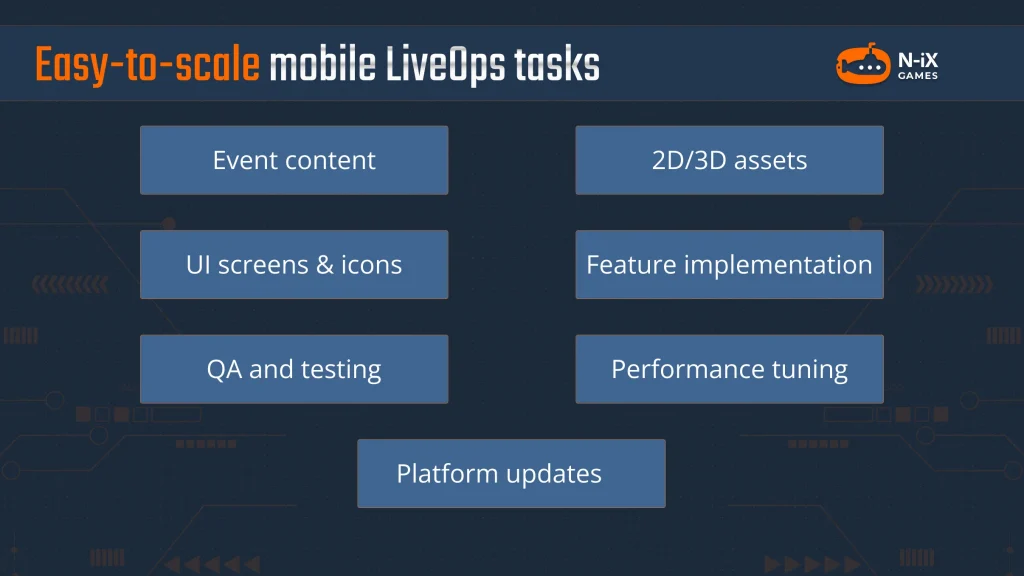
Not every part of LiveOps should be outsourced. The sweet spot is repeatable, execution-heavy work that can be clearly specified, while your internal team focuses on vision, design, and decision-making:
Content production
Content volume is one of the biggest pressures in mobile LiveOps. New characters, cosmetics, environments, and event visuals all take time, and art production is well suited for outsourcing when style guides are clear.
Games like Raid: Shadow Legends regularly release new champions, each requiring modeling, texturing, animation, and VFX. Outsourcing parts of that pipeline, such as 3D modeling or rigging, helps teams ship faster without overloading internal artists. Similarly, World of Tanks Blitz runs frequent seasonal events with themed skins, camo, and garage assets. External art teams can handle these event visuals while internal artists focus on core style and direction.
Event banners, icons, and limited-time screens can also be produced externally under the guidance of an in-house UI or UX lead. The goal is simple: internal teams define the look, external teams handle volume.
Feature implementation and engineering tasks
LiveOps updates often include more than content. Small features, tools, and technical upgrades add up quickly. When design specs are clear, such as a GDD for a new event or mode, external Unity or Unreal developers can implement them efficiently.
This also includes limited-time game modes, new quest chains, event systems, or minor gameplay extensions. External engineers can also take on technical maintenance tasks like engine upgrades, SDK integrations, or performance optimizations for new devices. These jobs are time-consuming but well-scoped, making them ideal to outsource.
This lets your internal engineers stay focused on core systems and long-term architecture, while external developers handle clearly defined, short-term work.
LiveOps QA and release support
Frequent updates mean frequent testing. Outsourcing parts of QA is often essential for LiveOps mobile games with tight release cycles.
External QA teams can handle regression testing, device coverage, event validation, and store compliance checks. For recurring events, they can test mechanics, timing, rewards, and edge cases before launch. This reduces risk and frees internal developers from spending large chunks of time on testing and emergency fixes.
Release support can also be outsourced. Preparing builds, submitting updates to app stores, and monitoring rollouts are operational tasks that fit well with external support teams.
Platform adaptations and technical updates
Mobile platforms change constantly. New OS versions, devices, and policies require ongoing updates. Outsourcing works well here because the tasks are platform-specific and predictable.
External specialists can handle OS compatibility updates, privacy changes, engine upgrades, or ports to other platforms. Engine-side updates, in particular, benefit from dedicated attention since they involve careful testing and incremental fixes. Offloading this work keeps your game stable without pulling your core team away from forward-looking development.
Maintaining quality and consistency at scale
Bringing external teams into your LiveOps workflow raises an obvious concern: quality. Players expect the same level of polish regardless of who built a feature or asset. Consistency is what keeps LiveOps games feeling cohesive over time. The good news is that this is mostly a process problem, not a talent one.
- Clear reviews and fast feedback: Treat external contributors like an extension of your team. Set up regular reviews and short feedback loops. Review art early, not just at final delivery. Check code through pull requests owned by internal senior developers. Catching issues early is cheaper than fixing them later. Over time, external teams learn your standards and need less correction, but feedback should always stay open and direct.
- Shared tools and version control: Everyone should work in the same pipeline. External developers commit code to your version control system. Artists follow the same asset structure, naming rules, and delivery formats as your internal team. Nothing should live outside the main project. Simple checklists help too. Each delivery should confirm testing, documentation updates, and build compatibility. Structure prevents mistakes when update cycles get tight.
- Strong style guides and asset libraries: Consistency starts with clear references. A solid art bible with examples, color rules, UI patterns, and do’s and don’ts removes guesswork for external artists. Keep an up-to-date asset library so teams can match scale and style. The same applies to code. Basic coding standards and architecture notes help external developers work faster and avoid breaking core systems.
- Fewer vendors, longer relationships: Switching vendors constantly creates friction. When you find a team that delivers reliable results, keep them close. Long-term partners understand your game, tools, and expectations. That reduces onboarding time and improves output quality. Many teams even include external partners in regular syncs to reinforce a shared sense of ownership.
At scale, quality comes down to leadership and communication. Outsourcing is not hands-off. Internal teams still set direction, review work, and own final decisions. When managed well, outsourcing lets you ship more without lowering the bar.
Benefits of a light outsourcing approach
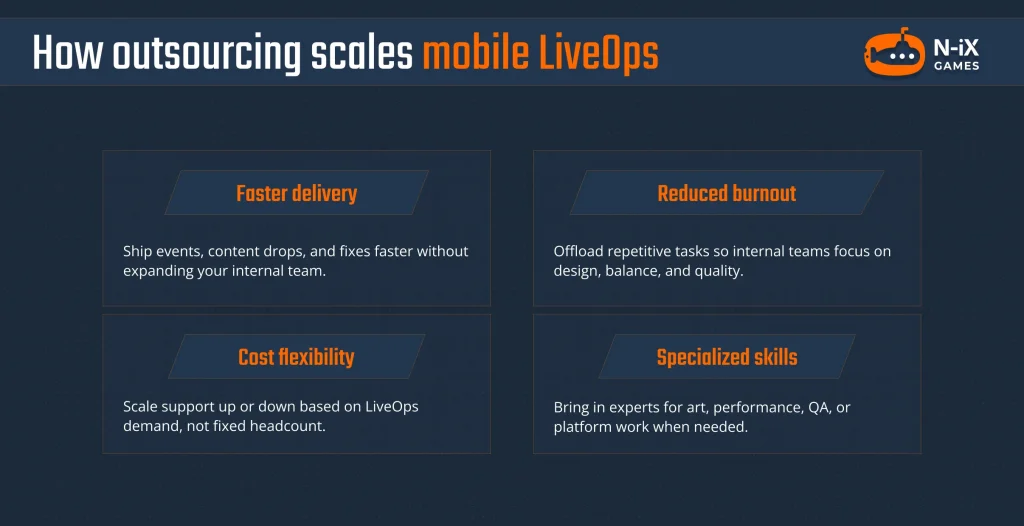
A lean outsourcing model helps teams scale mobile LiveOps without adding unnecessary complexity. The value comes from flexibility, focus, and better use of internal time.
Faster LiveOps without growing headcount
External support lets you ship updates more often than a small internal team could manage alone. You can maintain a steady cadence of events, content drops, and fixes without the delay of hiring and onboarding. External teams act as a flexible capacity you can bring in when deadlines tighten or content demand spikes. That keeps the game fresh and responsive without locking you into long-term staffing decisions.
Less burnout, better focus
LiveOps is relentless. Offloading repetitive or labor-heavy tasks reduces pressure on internal developers and artists. Your core team can focus on design, balance, community needs, and meaningful improvements instead of rushing to hit every update. This leads to higher-quality work and more sustainable team morale over time.
Predictable costs and flexible scaling
Outsourcing turns fluctuating workloads into manageable, planned costs. Instead of carrying a large permanent LiveOps team, you pay for support when you need it. It’s easy to scale up for major events and scale back during quieter periods. For smaller studios especially, this makes LiveOps mobile games easier to operate without financial strain.
Access to specialized skills on demand
Some tasks require expertise you don’t need every day. Outsourcing gives you access to specialists for shaders, AI, performance optimization, or high-end art without long-term hires. You get the right skills at the right time, and your game benefits from expertise that would be hard to justify in-house.
At its core, light outsourcing is about staying nimble. You expand execution capacity without bloating your team or losing control. The result is a healthier development process and a live game that can keep growing at a sustainable pace.
Conclusion
Scaling a live game doesn’t require a massive team or giving up creative control. It requires focus. With a lean outsourcing model, you keep ownership of vision, strategy, and priorities, while extending your ability to deliver consistent mobile LiveOps updates. Done right, this approach scales output without adding long-term complexity or risk.
LiveOps mobile games with N-iX Games
At N-iX Games, we help teams scale mobile LiveOps without losing focus or control. We work as an extension of in-house teams, supporting post-launch content, LiveOps pipelines, and full-cycle mobile game development. From fast production ramp-up to long-term LiveOps support, we know how to keep LiveOps mobile games moving at a sustainable pace.
Our projects
Netflix Stories
Netflix Stories required shipping multiple narrative-driven mobile games in parallel, each on a tight timeline. N-iX Games assembled dedicated teams covering art, animation, Unity development, and QA, while Netflix retained creative control over scripts and IP. This setup allowed up to five games to be developed simultaneously, with average production cycles of 10–14 months. The result was a steady release sequence and scalable production without overloading internal teams.
World of Tanks Blitz

For World of Tanks Blitz, N-iX Games provided art outsourcing focused on concept and 3D production. Our artists worked on tank skins, event visuals, and customization content designed for mobile performance and readability. Every asset followed strict style and performance guidelines and was reviewed in close coordination with the core team. This support helped expand seasonal content while maintaining visual consistency across LiveOps updates.
If you’re planning post-launch growth or need help scaling LiveOps games, let’s talk. We’re always open to discussing how outsourcing can support your mobile LiveOps strategy without compromising quality or ownership.